
Is Coworking Right for My Business? Coworking vs. Traditional Office Space Explained
Most businesses don’t wake up one morning excited to look for office space.
Usually, it comes up because something has shifted.
Maybe your team has grown.
Or working from home has stopped working.
Maybe you’re paying for space you barely use.
Or maybe you’re simply trying to run a healthy business without taking on unnecessary risk.
Coworking has now entered the chat.
Coworking is a flexible workspace model in which businesses and teams share professional office space costs, amenities, and infrastructure without committing to a long-term lease or managing an office.
This guide is meant to help you think clearly about whether coworking actually fits what your business needs right now.

Start with the real question: what problem are you trying to solve with office space?
Before comparing coworking vs. traditional office space options or pricing, it helps to pause and ask a simpler question:
What Office Space problem are We trying to solve?
For most teams, it’s one of a few things:
You want flexibility instead of a long-term commitment.
You need a professional place to work and meet.
You’re trying to reduce overhead without lowering standards.
You want your team to feel more connected and engaged.
You want to focus on running your business, not managing a property.
You need a hybrid work office space solution to increase employee satisfaction.
When office space becomes a barrier to growth or a source of stress, it’s usually time to rethink your setup. That’s where private office coworking memberships can become the solution.

When coworking works well for growing and evolving businesses
Coworking often makes sense for businesses that expect change or are craving simplicity.
That could mean:
A team that’s growing, or unsure how fast it will grow
A hybrid company that needs a consistent home base
A founder who doesn’t want to manage an office on top of everything else
A business that wants to stay lean while still investing in its people
In these situations, coworking can remove a lot of friction. You get space that’s ready to use, terms that allow for adjustment, and fewer operational details pulling focus away from your work.
When coworking may not be the best office solution
It’s worth saying plainly: coworking isn’t right for every business.
If your operations require highly specialized buildouts, involve large teams working in the space every day, or depend on infrastructure beyond a shared environment, a traditional office lease may be more appropriate.
The goal isn’t flexibility at all costs; it’s choosing office space that supports how your business actually operates day to day.

Looking beyond the monthly cost: coworking vs. traditional office space
Cost is usually one of the first things people look at, and understandably so.
Traditional office space often brings:
Buildout and furniture costs
Utilities, internet, cleaning, and maintenance
Time spent managing vendors and logistics.
But the real perk of coworking isn’t just the monthly rate. It’s everything that comes with it.
Coworking bundles your rate into a single, predictable shared office space cost. For many businesses, especially smaller teams, simplicity matters. It reduces surprises and makes budgeting easier.
When comparing coworking vs. traditional office space, the differences often come down to flexibility, risk, and how much time a business wants to spend managing its space.
Truthfully, coworking can save companies up to 80% on real estate costs, freeing up capital to reinvest in the business, employees, and the surrounding community.
Why office space flexibility becomes more valuable over time
Flexibility doesn’t always feel critical at the beginning.
It becomes important when:
Hiring plans change
A team shifts to hybrid work.
A project ends sooner than expected.
Priorities evolve
Having the ability to adjust without renegotiating a long-term lease or carrying unused office space can be the difference between feeling boxed in and feeling supported as the business changes. Coworking is the flexible office lease alternative.

The role of community in coworking spaces
Community means different things to different teams.
For some, it’s collaboration and connection.
For others, it’s simply being around people who are also building something.
At The Loading Dock, community isn’t a requirement. It’s there if and when it’s useful. Sometimes that looks like a helpful conversation. Sometimes it’s just the quiet motivation that comes from working alongside others who are focused and engaged.
Either way, proximity has a way of creating opportunities that don’t show up on a spreadsheet.
Hybrid and remote teams find that coming together at The Loading Dock does something a Zoom call never can — conference rooms, training spaces, and shared meals have a way of re-energizing a team that's been working apart.
How to evaluate a coworking space for your business
If you’re considering coworking, it’s worth looking past the photos.
A few practical questions to help you choose a coworking space:
How flexible are the terms, really?
Are there spaces for both focused work and collaboration?
Does it feel professional enough for your clients and team?
Is the environment well-run and consistent?
Can you picture your team working there day after day?
The best coworking spaces tend to support your work quietly, without adding friction or distraction.
So, is coworking right for your business?
If your business values flexibility, clarity, and a lower operational burden, coworking can be a strong option.
Coworking removes obstacles that slow teams down, creates room for growth or contraction, and allows leaders to focus on building the company rather than managing space.
Frequently asked questions about coworking
Is coworking good for small businesses?
Absolutely, for many small and growing teams, coworking offers professional office space without the long-term risk of a traditional lease. Over 60% of founders and executives reported that their companies have grown since joining The Loading Dock.
Is coworking cheaper than renting a traditional office?
In many cases, yes, especially when factoring in buildout costs, utilities, furniture, and long-term lease commitments. See how Fortune 500 companies saved 80% on real estate costs.
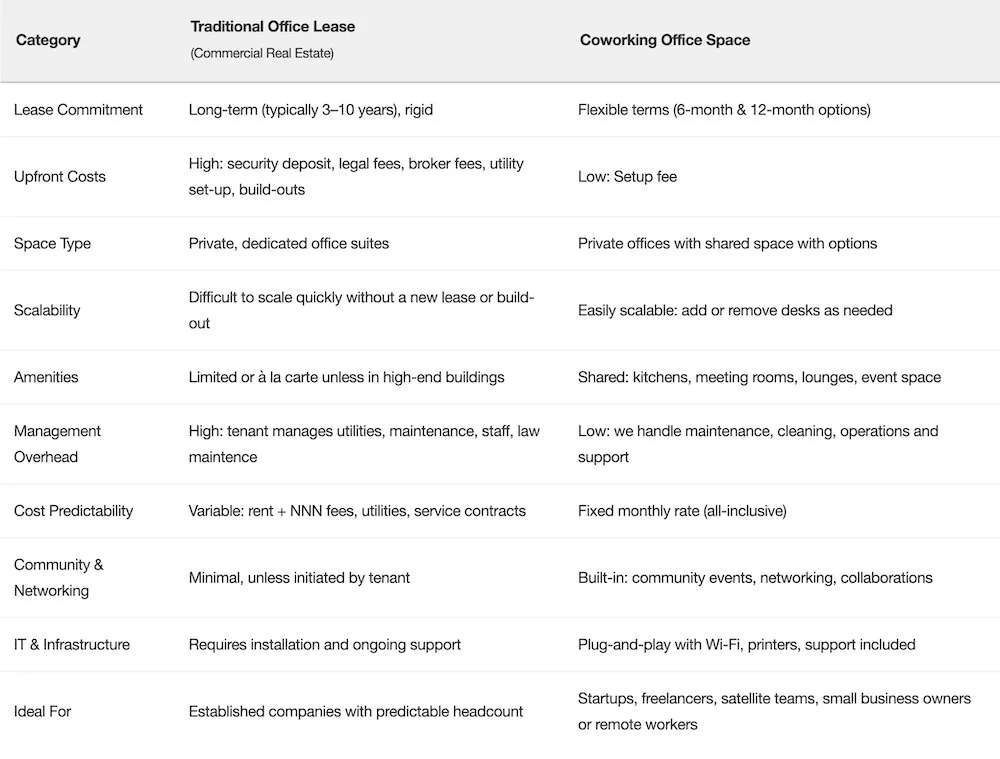
What’s the difference between coworking and a traditional office?
Coworking offers benefits for small teams by providing shared amenities, flexible terms, and reduced operational responsibilities, while traditional offices typically require long leases and hands-on management.
If you're exploring hybrid work office space in Raleigh, NC, or coworking space in Wake Forest, The Loading Dock has three Wake County locations ready to visit. Schedule your in-person tour today, and let's find the right fit for your team.